
Win-Back Campaign Framework: 8 Plays for Reactivating Dormant iGaming Players


Last verified: October 16, 2026
The retention team exports a list of 40,000 dormant players and hands it to the contact center with a single instruction: get them back. Without structure, the result is predictable. Agents dial top to bottom, the freshest players wait behind ones who left a year ago, caller IDs get flagged after the first big wave, and at least one call reaches a player who self-excluded last week.
This framework fixes that. It gives contact center managers eight independent plays for planning and running a win-back campaign, so agent hours go to the players most likely to return, and every call stays inside the operator's responsible gaming rules.
What Is a Win-Back Campaign in iGaming?
A win-back campaign is a coordinated outreach effort aimed at players who have already stopped playing, with the goal of getting them to log in and deposit again. Most email-marketing guides treat it as an automated message sequence. In iGaming, it usually runs across voice, SMS, WhatsApp and email at once, and the phone call often brings in the most deposits.
What counts as dormant is up to each operator. A common working definition, used in Optimove's analysis of more than 5.3 million players, is a player who has deposited in the past and has been inactive for 30 days or more. Some operators split that further into short-lapsed (30 to 90 days) and long-dormant (90 days and beyond) segments.
That threshold is also the line between retention and win-back. Retention work keeps active players engaged; win-back starts once they've already gone quiet. For the wider retention picture, including VIP hosting and welcome calls, see our guide to player retention strategies for iGaming teams.
Why Timing Decides Win-Back Results
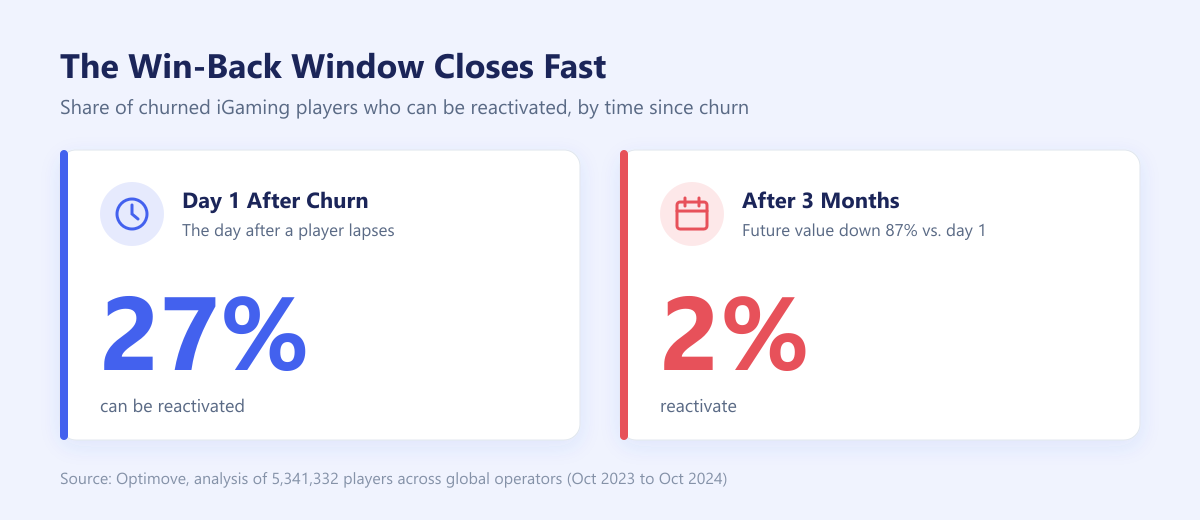
How quickly you reach a lapsed player shapes everything else in a win-back campaign. Optimove's data shows a steep drop-off:
- Day 1 after churn: 27% of players can be reactivated.
- After 3 months: only 2% reactivate, and their future value is 87% lower than a player won back on day 1.
The channel matters too. When the SOFTSWISS player reactivation team brought back 13,000 dormant players in 2022, 82% of the resulting deposits followed phone calls and 18% followed text messages. Voice isn't the only channel worth using, but it's the one most email-first win-back playbooks leave out.
How Win-Back Campaigns Are Measured
For a comprehensive overview of your win-back efforts, track these KPIs per player segment, not just for the campaign as a whole:
- Contact rate: live conversations divided by players dialed.
- Reactivation rate: players who logged in and deposited, divided by players contacted.
- Deposit value per reactivated player, compared with the bonus cost to win them back.
- Cost per reactivated player: agent time, telecom and incentive spend, divided by reactivations.
- Opt-out and complaint rate: a rising number is an early warning that cadence or targeting is off.
The Win-Back Campaign Framework: 8 Plays
Those metrics tell you whether a win-back campaign is working. The eight plays below are how you move them, covering everything from who gets called first to what happens after the call ends. Each play stands on its own, so you can pick the ones that fit your operation and apply them in any order.
1. Work the List by Days Since Last Deposit
A dormant list sorted alphabetically or by player ID wastes the most valuable days. Sort by days since last deposit and split the list into waves:
- Wave A (30 to 45 days): highest reactivation odds, first claim on agent time.
- Wave B (46 to 90 days): still worth live calls for mid- and high-value players.
- Wave C (90+ days): lower odds; better suited to automated touches first.
The waves only work if they stay current. Refresh them daily or weekly, so new lapses enter Wave A as soon as they cross the threshold instead of waiting for the next monthly export.
2. Re-Check Consent and Player Protection Flags Right Before Dialing
A list can be clean when it's built and out of date by the time an agent dials it. Players self-exclude, set deposit limits, withdraw marketing consent, or get flagged by the safer-play team in the days between export and call.
That's why the suppression check should run as close to dial time as your systems allow, ideally through a live sync with the player account management (PAM) platform or CRM rather than a static file. Requirements differ by market (the UK, Malta, Ontario and others each set their own rules on marketing contact and player protection), so confirm the rules for every jurisdiction on the list with your compliance team.
3. Match the Channel to Player Value
Not every dormant player needs a human call, and not every one should get only an SMS:
- High-value and former VIP players: a personal call from their VIP host or a senior agent, with full account history on screen.
- Mid-value players: live agent calls through a dialer, with SMS or WhatsApp as the follow-up.
- Low-value or long-dormant players: an automated first touch, then live calls only for those who respond.
For the automated tier, AI voice agents built for iGaming can place reactivation calls with seasonal offers or product updates, in multiple languages and across time zones.
4. Ask Why They Left Before Mentioning a Bonus
Some dormant players left because they were bored. Others left because a withdrawal took two weeks, a KYC check stalled, or a game kept crashing. Leading with a bonus to the second group sounds tone-deaf, and it doesn't fix the reason they'll leave again.
A better approach is to train agents to open with a short check-in ("we noticed you haven't played in a while, was anything wrong with your account?") and to log the answer as a reason code: payment issue, verification problem, product or game issue, moved to a competitor, or no reason given. Players with an unresolved issue go to a resolution path before any offer is discussed.
5. Call in the Player's Own Play Window
A player who used to log in on weekday evenings is unlikely to pick up at 10 a.m. on a Tuesday. Use historical session data to schedule calls in the hours each player was most active, converted to their local time zone, and within the calling hours each market allows.
There's an operational benefit, too. For multi-market operations, scheduling by play window spreads the dialing load across the day instead of concentrating every call in the contact center's own business hours.
6. Protect Caller ID Before a High-Volume Wave
Win-back campaigns are some of the highest-volume outbound pushes an iGaming contact center runs, which makes them a common trigger for carrier spam labels. Once a number shows "Spam Likely," pickup rates fall for every campaign that uses it.
To ensure good campaign performance for a large wave:
- Dial from local numbers in each target market. Virtual phone numbers in 150+ countries make this practical across regions.
- Spread volume across a number pool rather than one line.
- Monitor reputation with a tool like Spam Checker, so a flagged number gets pulled before it drags down the whole wave.
7. Cap Attempts Per Segment, Then Recycle or Retire
Unlimited redials annoy players and burn caller IDs. Set a maximum number of attempts per segment, a minimum gap between them, and a clear end point:
- High-value: more attempts over a longer window, mixed with a personal SMS or WhatsApp message.
- Mid- and low-value: fewer attempts, then a single written message, then retire the record for this campaign.
You don't have to enforce these limits by hand. A predictive dialer applies them automatically: List Recycle Rules redial missed players on your schedule, answering machine detection (AMD) keeps agents on live conversations, and Workflow Builder can send a follow-up SMS automatically based on the call outcome.
8. Write Every Outcome Back to the Player Record
A win-back call produces information even when the player doesn't return: a callback request, an unresolved payment issue, a preference to be contacted only by email, or a request to stop contact entirely. If that outcome stays in the dialer, the next campaign repeats the same mistakes.
To avoid that, map call dispositions to fields in your CRM or PAM, and agree with the retention team which outcomes trigger which next step. "Requested callback Friday" should create a task; "asked not to be called" should update consent; "unresolved withdrawal" should open a ticket. Our article on where player communication fits in the iGaming stack covers this integration side in more depth.
Win-Back Campaigns in Practice
On paper, each play is a single decision. On a real dormant list, several of them work together, and the mix changes with the players you're trying to reach. The three scenarios below show how a contact center might combine the plays for a seasonal sportsbook audience, a single high-value casino player, and a large low-value segment.
A Sportsbook Before the New Season
A sportsbook sees thousands of football bettors go quiet every summer. Instead of one large reactivation push on the opening weekend, the contact center starts three weeks earlier. Players who lapsed after the previous season's final are sorted by value, and the top tier gets personal calls about the new season's markets. Calls are scheduled for weekday evenings and the hours before weekend matches, when this group used to log in. Mid-value players get one agent call and a WhatsApp follow-up. By the first match day, agents are handling returning players' account questions instead of cold-dialing the whole list.
A Lapsed Casino VIP After a Withdrawal Complaint
A former VIP hasn't deposited in 40 days. The account notes show a delayed withdrawal and an angry support ticket just before they stopped. The VIP host's call opens with the withdrawal, not an offer: they confirm it was paid, explain what caused the delay, and ask whether anything else is unresolved. The player mentions a pending verification document. The host logs the reason code, routes the document to the KYC team, and schedules a follow-up call for when it clears. The bonus conversation happens on that second call, once the original problem is fixed.
A Long-Dormant, Low-Value Segment
An operator has 25,000 low-value players who haven't deposited in more than 90 days. Live calls to all of them would cost more than the segment is likely to return. The team runs a suppression check, then sends an automated first touch by SMS with a simple offer. Only players who click or reply go into a short dialer campaign capped at two attempts. Everyone else is retired from this campaign, and agents spend their hours on the small group that has already shown interest.
Make Win-Back a Timed Campaign, Not a List Dump
The plays above share one idea: a dormant list is worth the most on the day it's built and less every day after. Contact center managers who sort by recency, check eligibility at dial time, match channel to value, and protect their numbers get more reactivations from fewer agent hours.
If you're planning win-back campaigns across voice, SMS and WhatsApp, Squaretalk's contact center software for iGaming brings dialing, messaging and AI voice agents into one platform. Book a demo to see how it fits your player journey.
FAQ
How many call attempts should a win-back campaign make per player?
There's no universal number, and local rules may set limits. A practical approach is to give high-value players more attempts over a longer window, and cap mid- and low-value players at a few attempts before switching to a single written message and retiring the record.
When is a player considered dormant?
Each operator sets its own threshold. A common working definition is a player who has deposited before and has had no activity for 30 days or more. Many operators also separate players lapsed under 90 days from long-dormant players beyond 90 days, because reactivation odds differ sharply.
Should agents offer a bonus on the first win-back call?
Not by default. Agents should first ask whether anything went wrong with the account. If the player left over a payment, verification or product issue, fixing that comes first. An offer makes more sense once the original problem is resolved or the player confirms there wasn't one.
Can AI voice agents run win-back calls?
Yes, for the right segments. AI voice agents work well for high-volume, lower-value dormant segments where a human call isn't cost-effective, and they can call in multiple languages around the clock. High-value players and anyone with a complaint or a player protection flag should still reach a trained agent.
Is email enough for a win-back campaign?
Email is cheap and easy to automate, but on its own it often misses players who have stopped opening brand messages. Combining email with SMS, WhatsApp and phone calls gives each segment the channel it's most likely to respond to.