
9 Player Retention Strategies for iGaming VIP and Contact Teams

A player database is an asset that loses value every day nobody manages it. Players lapse, deposits slow, and VIPs drift toward a competitor's welcome offer. Acquisition fills the database. Retention decides how much of it is still worth anything six months later.
That means knowing which players to contact, when, through which channel, and when to leave someone alone. The nine strategies below are how retention and VIP teams keep a player base active and valuable without crossing responsible iGaming lines.
Last verified: October 12, 2026 (regulatory dates and Squaretalk product features).
What Player Retention Means in iGaming
Player retention is the share of players who keep depositing and playing over a given period, and the work an operator does to keep that share high. Two related terms often get blurred:
- Retention targets players who are still active, including those showing early signs of slowing down.
- Reactivation targets players who have already gone dormant, usually defined by the operator as a set number of days without a deposit or session.
Both matter because a player who stays is cheaper to serve than one you have to find again. Research by Frederick Reichheld of Bain & Company, cited in Harvard Business Review, found that increasing customer retention rates by 5% increases profits by 25% to 95%.
How Retention Is Measured
Most iGaming teams track a small set of database-health metrics:
- Retention rate: active players at the end of a period who were also active at the start, divided by players active at the start.
- Churn rate: the inverse, meaning the share of active players who stopped playing in the period.
- Reactivation rate: dormant players who returned and deposited, divided by dormant players contacted.
- First-to-second deposit conversion: the share of new depositors who make a second deposit, an early signal of whether a player will stay.
- Value per active player: net revenue divided by active players, which shows whether retention efforts keep the right players, not just more of them.
The Player Retention Framework: 9 Strategies
Each strategy below stands on its own. Use the ones that address the gaps in your database today.
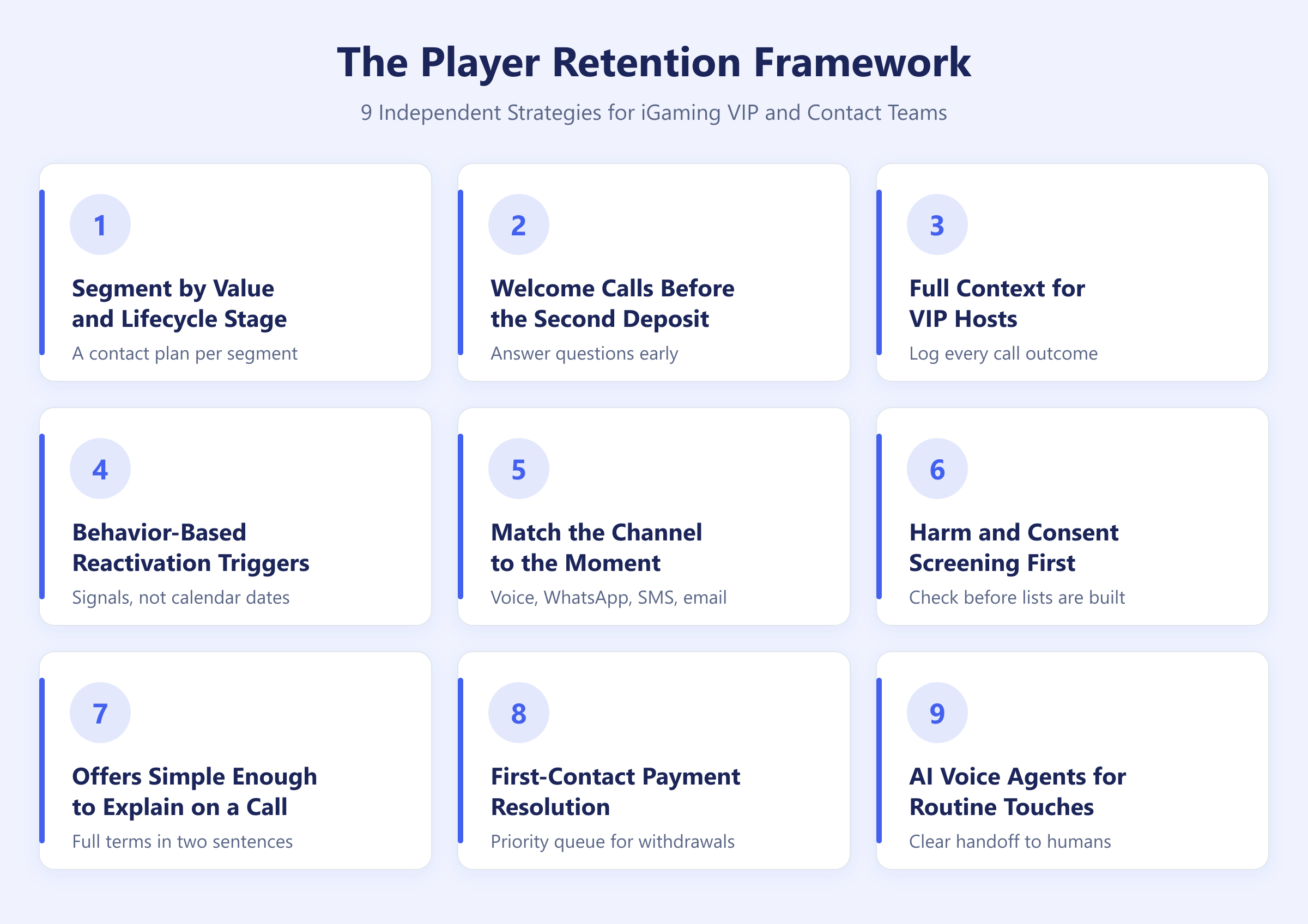
1. Segment Outreach by Player Value and Lifecycle Stage
A single retention campaign for the whole database treats a two-week-old depositor the same as a five-year VIP. Split the database into a few segments that each get a different contact plan:
- New depositors: onboarding and the second deposit
- Active regulars: light-touch engagement, no heavy promotion
- At-risk players: declining session frequency or deposit size
- Dormant players: reactivation, with clear stop rules
- VIPs: a named host who manages the relationship one-to-one
The segment should decide who calls, how often, and on which channel. A dormant low-value player might get one SMS. A VIP showing the same drop gets a call from their host.
2. Make Welcome Calls Before the Second Deposit
The gap between a first and second deposit is where many new players quietly disappear. A short welcome call in the first days answers the questions that otherwise turn into abandonment: how withdrawals work, what verification is still pending, and how to set deposit limits.
Keep the call service-led rather than promotional. A player who has had a useful conversation with a real person has a reason to come back that a bonus email doesn't create.
3. Give VIP Hosts Full Player Context Before Every Call
A VIP host who opens a call by asking what the player last raised has already lost ground. Before any VIP contact, the host should see recent activity, open issues, past promises, and the last conversation's outcome in one view.
This works in both directions. Every call outcome, whether it's a resolved complaint, a preference, or a request not to be contacted for a month, needs to land back on the player record. Otherwise the next host or the next campaign starts from stale information. Squaretalk's contact center platform for iGaming supports VIP queues with dedicated specialists and full player history, and syncs voice and messaging workflows with an operator's CRM or PAM.
4. Trigger Reactivation From Behavior, Not the Calendar
"Call everyone dormant for 30 days on the first of the month" ignores why each player stopped. Behavior-based triggers are more precise:
- A player's session frequency drops sharply against their own baseline
- A favorite sport's season ends
- A player's last session ended with an unresolved support ticket
Once a trigger fires, a power dialer works well for retention lists because it dials one number at a time per agent, giving the agent a moment to review the player before the call connects. For larger dormant segments, a predictive dialer raises agent talk time. Our guide to predictive dialers for iGaming covers when that tradeoff makes sense.
5. Match the Channel to the Moment
Different retention moments call for different channels:
- Voice for VIPs, complaints, and anything that needs a conversation
- WhatsApp for two-way follow-ups the player can answer on their own schedule
- SMS for short confirmations, a missed-call follow-up, or a callback link
- Email for terms, statements, and longer information
The channel also has to be one the player agreed to. Squaretalk's WhatsApp integration lets the same team handle voice and WhatsApp conversations side by side, so a follow-up message doesn't start a separate, disconnected thread.
6. Screen for Harm Indicators and Marketing Consent Before Any Contact
Some signals that look like engagement are also signs of harm: rising deposits, longer sessions, chasing losses. A retention call to that player can do real damage, and in many markets it is a regulatory breach.
The UK Gambling Commission's customer interaction guidance requires remote licensees to monitor seven indicator categories, including customer spend, time spent playing, and use of player management tools. UK operators must also collect marketing opt-in per product and per channel since May 2025.
Rules differ by licensing market, so build the check around each jurisdiction where you hold a licence. Whatever the market, the operating principle is the same: run harm and consent checks before a player enters any retention list, not after an agent is already on the call.
7. Keep Offers Simple Enough to Explain on a Call
If an agent needs two minutes to explain a bonus's terms, the offer is working against retention. Complicated wagering requirements produce complaints, and complaints produce churn.
Regulators are moving the same way. In Great Britain, the Gambling Commission capped wagering requirements at 10 times and banned mixed-product bonuses from January 19, 2026. A useful internal test: if an agent can't state the offer's full terms in two sentences, rework the offer.
8. Resolve Payment and Withdrawal Problems on First Contact
A delayed withdrawal or a failed deposit is a churn moment. The player is frustrated, has money at stake, and is one click from a competitor. Handle these contacts with the same priority as any retention campaign:
- Route payment and withdrawal issues to a priority queue
- Give agents the transaction status, so they aren't guessing
- Call back proactively when a withdrawal is held for verification, before the player chases it
A player who gets a clear answer and a fixed problem on the first contact often ends up more loyal than one who never had an issue.
9. Use AI Voice Agents for High-Volume, Routine Touches
Not every retention contact needs a human. Routine calls such as KYC reminders, balance questions, event invitations, and reactivation offers to large low-value segments can go to an AI voice agent. That frees human agents and VIP hosts for the conversations that need judgment.
Squaretalk's AI Voice Agents for iGaming handle player reactivation, onboarding and verification reminders, and Tier 1 support in multiple languages, around the clock. Set clear handoff rules so complex or sensitive cases, including any harm signal, reach a trained agent along with the conversation context.
Player Retention Strategies in Practice
A Sportsbook After a Major Tournament
A sportsbook sees a wave of new depositors during a major international football tournament. When the final ends, activity drops sharply. Instead of a single "we miss you" blast, the retention team segments the tournament cohort. Players who made only one deposit get a welcome-style service call about withdrawals and limits (Cohort 1). Players with a domestic league starting soon get a WhatsApp message about the new season (Cohort 2). Anyone who opted out of phone marketing, or who shows harm indicators, is filtered out before the lists go to the dialer. This way the team keeps a slice of the tournament cohort it would otherwise have lost by default.
A Casino VIP After a Delayed Withdrawal
A long-standing casino VIP has a large withdrawal held for additional verification. The player emails support twice and gets a template reply each time. Under the framework, the hold triggers a priority-queue callback from the player's own host, who can see the verification status and the earlier emails. The host explains what's needed and when the funds will clear, and logs the outcome. No bonus is offered to smooth it over. The fix and the conversation do that work.
Multilingual Reactivation for a Dormant Segment
An operator licensed in several Latin American markets has thousands of dormant low-value players across Spanish and Portuguese speakers. Calling all of them with human agents would tie up the team for weeks. Instead, an AI voice agent runs the first reactivation touch in each player's language, with a simple offer that can be explained in one breath. Players who engage or ask complex questions transfer to a human agent. Everyone else gets a single SMS follow-up and then drops off the list.
Keep the Database Worth Managing
Player retention comes down to the quality of each contact: the right player, the right moment, the right channel, and a clear reason to stay. The strategies above work independently, so start with the gap that costs your database the most, whether that's second deposits, dormant VIPs, or slow withdrawals.
If your retention and VIP teams are juggling disconnected dialers, messaging apps, and player records, talk to our team about running voice, WhatsApp, SMS, and AI voice agents from one platform connected to your CRM or PAM. You can also read more about where player communication fits in the iGaming stack.
FAQ
How often should you contact inactive players?
There's no universal number, and frequency should depend on the player's value, consent, and how long they've been dormant. A practical approach is a short sequence of two or three touches across different consented channels, then a stop rule. Contacting a dormant player every week tends to produce opt-outs, not deposits.
What is the difference between player retention and reactivation?
Retention focuses on players who are still active, including those showing early signs of slowing down. Reactivation targets players who have already stopped playing for a period the operator defines as dormant. Retention is usually cheaper and more effective, because an active player still has a relationship with the brand.
Can AI voice agents handle VIP players?
AI voice agents suit routine tasks such as reminders, invitations, and simple account questions, including for VIPs who prefer quick answers. The relationship itself should stay with a human host. Any complaint, large transaction issue, or sign of harm should be transferred to a person with full context.
Which metrics should a VIP team track?
VIP teams usually track retention rate within the VIP tier, value per VIP player, time to resolve VIP issues, and how many VIPs downgrade or go dormant each month. Contact outcomes matter too: whether calls were answered, what the player raised, and whether follow-ups happened as promised.
Are retention calls allowed under responsible gambling rules?
Retention calls are generally allowed where the player has consented to that channel and shows no harm indicators, but the details depend on the licensing jurisdiction. In Great Britain, operators need per-product, per-channel marketing consent and must act on harm indicators. Check each market's rules before building contact lists.