
Nextiva Pricing in 2026: Plans, Add-On Costs, and What You'll Actually Pay

Nextiva's pricing page lists three small-business plans: Core at $15 per user per month, Engage at $25, and Scale at $75, all billed annually. That $15 headline is the number most buyers remember. It's also the number that changes the most between the pricing page and the invoice, because it depends on paying for a full year up front. Also, a true contact center, with agent queues, omnichannel routing, and outbound dialing, is a separate per-agent product starting from $75 per agent per month, with its higher tiers quote-based.
Nextiva restructured its plans in early 2026, collapsing four small-business tiers into three and splitting its contact center into its own per-agent lineup. Below is what each plan costs today, what it includes, which add-ons and fees change the total, and a realistic per-seat estimate once your team is up and running.
Nextiva pricing plans at a glance (2026)
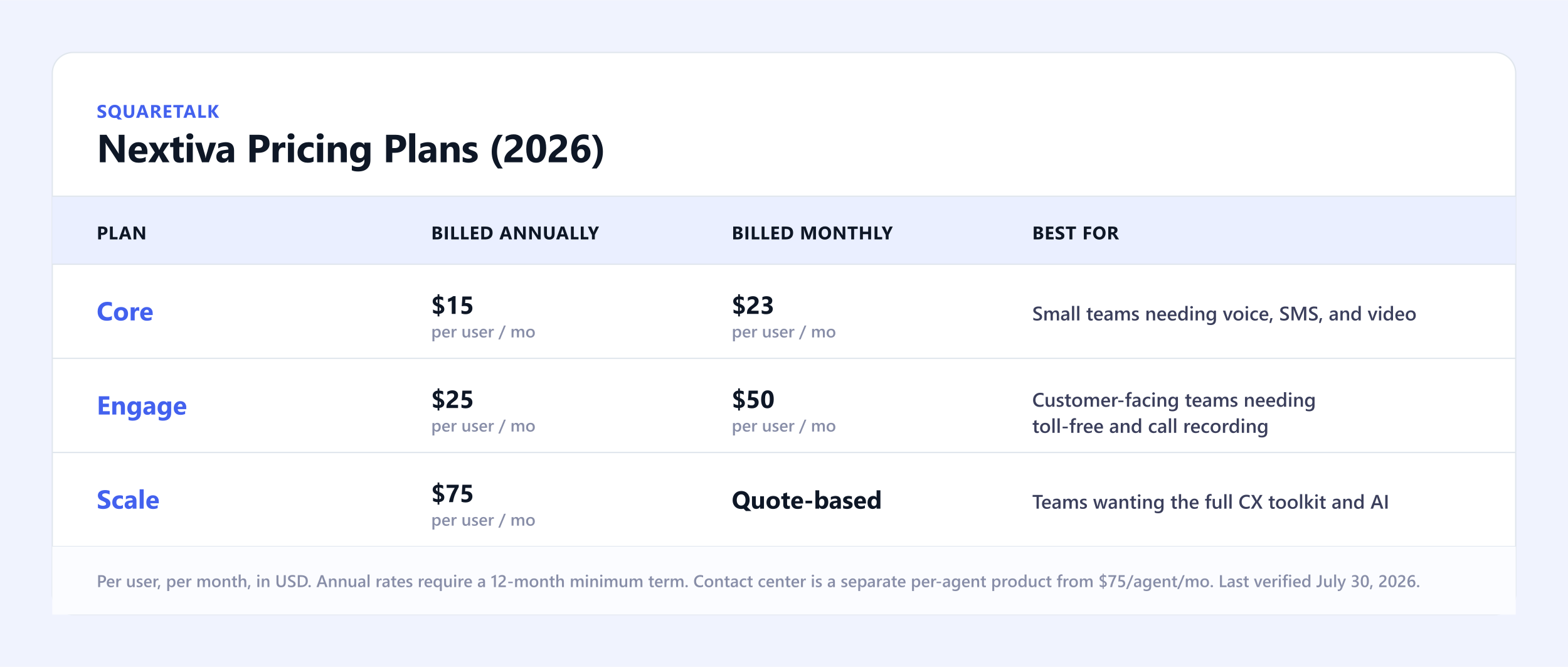
Nextiva's small-business lineup is three per-user tiers. Annual billing is where the advertised prices come from; paying monthly costs noticeably more on the two lower tiers.
| Plan | Billed annually | Billed monthly | Best for |
|---|---|---|---|
| Core | $15/user/mo | $23/user/mo | Small teams needing voice, SMS, and video |
| Engage | $25/user/mo | $50/user/mo | Customer-facing teams needing a toll-free number and call recording |
| Scale | $75/user/mo | Quote-based | Teams wanting the full customer-experience toolkit and AI |
Prices are per user, per month, in USD, and reflect Nextiva's published US rates for new small-business customers. Annual pricing requires a 12-month minimum term. Last verified: July 30, 2026 on Nextiva's plans and pricing page. Nextiva uses regional and contract-based pricing, so rates differ by market and can change; confirm current numbers before you buy.
What each Nextiva plan includes
The step between tiers is mostly about channels, reporting depth, and how much of the customer-experience toolkit you get. Every plan includes inbound and outbound voice, business SMS, video meetings, team chat, and the mobile app.
Core ($15/user/month)
Core covers the basics of a cloud phone system: unlimited inbound and outbound calling, 100 SMS per user per month, video meetings, team chat, call routing, and three social-media and online-review accounts. It's a fit for a small team that mainly makes and takes calls and wants everything in one app.
What it leaves out matters once a team gets customer-facing. Core has no included toll-free number, no call recording, and no live chat or chatbot; those come with the next tier. Simply said, the Core plan is suitable for support teams that do not take calls.
Engage ($25/user/month)
Engage is Nextiva's most popular tier, and it's aimed at teams that talk to customers all day. It adds customer-to-team SMS, a toll-free number with up to 2,000 included minutes, call recording, advanced reporting, an inbound call center, and live chat with a chatbot. SMS jumps to 500 per user per month and social accounts to 30. For most sales and support teams evaluating Nextiva as a working system, Engage is the realistic starting point rather than Core.
Scale ($75/user/month)
Scale is Nextiva's full customer-experience package on the small-business side. It adds blended inbound and outbound voice with web chat, AI transcription and summaries, skills-based routing, and journey orchestration, plus unlimited SMS and social accounts. Teams pick Scale when they want AI and routing on a per-user plan without moving to the separate per-agent contact center.
Nextiva contact center pricing (per agent)
Here's the distinction that catches a lot of buyers. Nextiva prices its small-business plans per user and its contact center per agent, and those aren’t the same seat. To help navigate the terminology, it is useful to say in these terms “user” is anyone in a company who needs a phone line - the sales rep but also the office manager and the receptionist. An “agent” in contrast is specifically a frontline contact-center worker running queues, with the heavier machinery that job requires wrapped around them: skills-based routing, supervisor monitoring, workforce management, and outbound dialing. It's always one person, but Nextiva's naming of the license, and the price, are not.
So the Core, Engage, and Scale plans above are Nextiva's small-business, per-user product. A dedicated contact center, built around agent-based routing, workforce management, and outbound dialing, is a separate product priced per agent, with three tiers:
| Plan | Price | What it adds |
|---|---|---|
| Essential | From $75/agent/mo | Voice and web chat, journey orchestration, AI transcription and summary, skills-based routing |
| Professional | Quote-based | Email and SMS channels, advanced self-service, real-time supervisor tools, PCI-DSS payments, and progressive and predictive dialing |
| Premium | Quote-based | Workforce management, unlimited skills-based routing, advanced analytics, unlimited channels |
The practical consequence is about outbound dialing. If your team's job is dialing lists at volume, progressive and predictive dialing don't appear until the Professional tier of the contact-center product, which is quote-based. So a small sales team that starts on Engage at $25 and later needs a real dialer isn't upgrading within the small-business plans; it's moving to a per-agent product at three times the entry seat cost or more. Budgeting for Nextiva means deciding early which of the two products you actually need, because a per-user seat and a per-agent seat are priced on different units and different scales, so you can’t compare them one to one or slide between them along a single upgrade path.
Nextiva add-on costs and fees that change your real bill
Choosing the right product is only the first half of the budgeting. Even once you’ve picked a per-user plan or the per-agent contact center, the tier price is a starting point, not the final number. Nextiva layers a handful of costs on top of the per-seat rate, some optional and some unavoidable, and each one widens the gap between the advertised figure and what actually shows up on the invoice:
- XBert AI Receptionist: Nextiva's AI receptionist answers calls, texts, and chats around the clock. It's an add-on layered on any plan, not a bundled feature, so it carries its own cost on top of your per-user rate.
- Toll-free and overage usage: Core has no included toll-free number, and each plan includes a capped bucket of toll-free minutes (up to 2,000 on Engage, up to 10,000 on Scale). Volume beyond that is billed as usage.
- Annual-commitment terms: the advertised $15 and $25 rates apply to new small-business customers signing a 12-month minimum term. Month-to-month billing raises Core to $23 and Engage to $50 per user, so the "annual saving" is really the cost of committing for a year.
There's also a category-wide cost that has nothing to do with any single vendor's plan: US telecom regulatory fees. Interconnected VoIP providers must contribute a percentage of their interstate and international revenue to the federal Universal Service Fund, and that factor was set at 38.8% for the third quarter of 2026 (FCC). Providers are allowed to pass this through as a line-item surcharge, so the total you pay sits above the advertised per-seat rate. These are US rules; regulatory charges vary by country, so teams outside the US see a different set of fees.
What you'll actually pay: a realistic per-seat estimate
Take a 15-person sales team. On Engage at $25 per user per month (annual), the plan alone is about $375 per month. That covers calling, SMS, a toll-free number, call recording, and reporting, but not AI transcription, journey orchestration, or dialing at volume.
Move that team to Scale for AI and routing on the per-user side, and the plan runs $75 per user, or about $1,125 per month for 15 seats. If the same team decides it actually needs a contact center with progressive or predictive dialing, it isn't upgrading the small-business plan at all; it's moving to the per-agent product, where dialing sits in the quote-based Professional tier above the $75 Essential entry point.
The pattern holds at most team sizes: the entry number is reachable, but the capabilities that make the platform useful for a working sales or support operation, dialing, AI, and true contact-center routing, are priced as higher tiers or a separate product. That's not a hidden fee so much as a structure worth mapping before you commit, so the plan you approve matches the plan you'll actually run.
How Nextiva pricing compares
Nextiva is an established platform, and for a business that wants unified voice, video, chat, and SMS across the whole company in one familiar app, that breadth is a genuine strength. The trade-off is the split between the per-user plans and the per-agent contact center: a sales or support team that needs dialing and routing tends to cross that line and pay per agent.
Squaretalk takes a different approach to packaging. Its published Core plan is $15 per user per month, and Connect at $25 (the same price as Nextiva Engage) folds WhatsApp Business messaging, SMS, and AI call summarization, sentiment analysis, and transcription into the plan, with a monthly AI-analytics allowance, rather than as separate subscriptions. To be clear about the parity: Squaretalk also sets per-plan seat minimums, meters its AI by the minute with a monthly commitment and no rollover, sells its predictive dialer as a separate product line rather than bundling it into the base plan, and quotes its top tier instead of publishing it. The honest difference isn't that one vendor has extras and the other doesn't; it's the entry price and how much omnichannel and AI capability lands inside a single per-user plan before you cross into a separate product.
If you're weighing options, a fuller Nextiva alternatives breakdown is worth a look before you decide.
FAQ
Is Nextiva free? No. Nextiva offers a demo and a trial for new customers, but there's no permanent free plan. After that, you move to a paid small-business plan starting at $15 per user per month on annual billing, or $23 per user per month billed monthly.
How much does Nextiva cost per user? Nextiva's small-business plans run $15 to $75 per user per month on annual billing: Core at $15, Engage at $25, and Scale at $75. Month-to-month billing raises Core to $23 and Engage to $50. The contact center is a separate product starting from $75 per agent per month.
Does Nextiva charge setup or hidden fees? There's no standard software setup fee, but your invoice can exceed the per-seat rate because of add-ons like the XBert AI Receptionist, toll-free overage, and pass-through regulatory charges such as the US Universal Service Fund fee. Annual rates also require a 12-month minimum term.
What is the cheapest Nextiva plan? The cheapest plan is Core at $15 per user per month billed annually ($23 monthly). It covers voice, SMS, video, and team chat, but leaves out call recording, a toll-free number, and live chat, which start at the Engage tier.
Is Nextiva's contact center worth the price? The per-agent contact center can be worth it for teams that need omnichannel routing, workforce management, and dialing, and are already invested in Nextiva. Teams focused mainly on outbound calling and cost predictability often find a platform that includes dialing and AI in a lower-priced per-user plan a closer fit; compare total cost for the features you'll actually use.
Ready to see what an all-in contact center plan looks like without crossing into a separate per-agent product? Talk to our sales team for a walkthrough and a quote tailored to your team.