
AI Voice Agents and Customer Trust: What Collections Teams Need to Get Right


Debt collection teams are increasingly relying on AI voice agents to automate outbound and inbound conversations at scale. For managers, the benefits are clear: increased contact capacity, reduced human workload, and more cost-efficient operations. If recipients engage with the automation, that is.
Debt collection is already a high-friction, high-sensitivity environment, where customers are cautious about unexpected calls involving debt, identity verification, and payment requests. Adding automation gives them another reason to scrutinize the interaction. If customers don't see an AI-led call as legitimate, accurate, and safe to act on, the technology loses effectiveness. More calls get abandoned, human agents get buried under transfer requests, and debts take multiple contacts to resolve.
The practical question for many collection managers, then, becomes how to make an AI-led collections call credible enough for debtors to engage with. In this article, you'll find practical actions to strengthen customer trust, starting with how the call is presented, verified, handled, and confirmed.
How are AI voice agents used in debt collections?
In first- or third-party operations, AI voice agents handle high-volume, repetitive, and low-complexity tasks. They often make first-contact outreach for:
- Pre-due reminders
- Early-stage past-due contact
- Right-party verification
- Promise-to-pay capture
- Broken-promise follow-ups
- Payment arrangements within approved parameters
- Aged-portfolio re-engagement
On the inbound side, AI voice agents typically handle 24/7 multilingual balance, due-date, and payment-status questions, walk customers through payment links and self-service portals, or present hardship options.
For many people, AI voice agents are the primary touchpoint with a debt collection company. The quality of the interaction determines the relationship and how much confidence they have in your brand, so winning them over becomes a business goal for many companies.
What makes trust a concern in AI-led collections?
In debt recovery, the interaction starts from an inherently difficult position. The outbound collection call's sequence almost exactly matches the behavioral pattern consumers are taught to treat cautiously:
Unknown caller → claims you owe money → knows something about you → asks you to verify yourself → asks for payment
AI voice agents don't seem to face more mistrust simply because they are automation. In fact, a 2026 study of debt collection interactions across 11 European countries found no significant difference in overall trust between AI-mediated and human interactions.
The issue appears when AI takes over more complex topics. Collections calls can quickly move from confirming a balance to discussing hardship, agreeing repayment terms, or taking payment. A Yale study of AI collection calls found that promises made to automated callers were broken more often than promises made to people.
For collections teams, the implication is straightforward: the more consequential the AI's role becomes, the more important it is to give customers reasons to trust the interaction.
Six actions that improve trust in an AI collections call
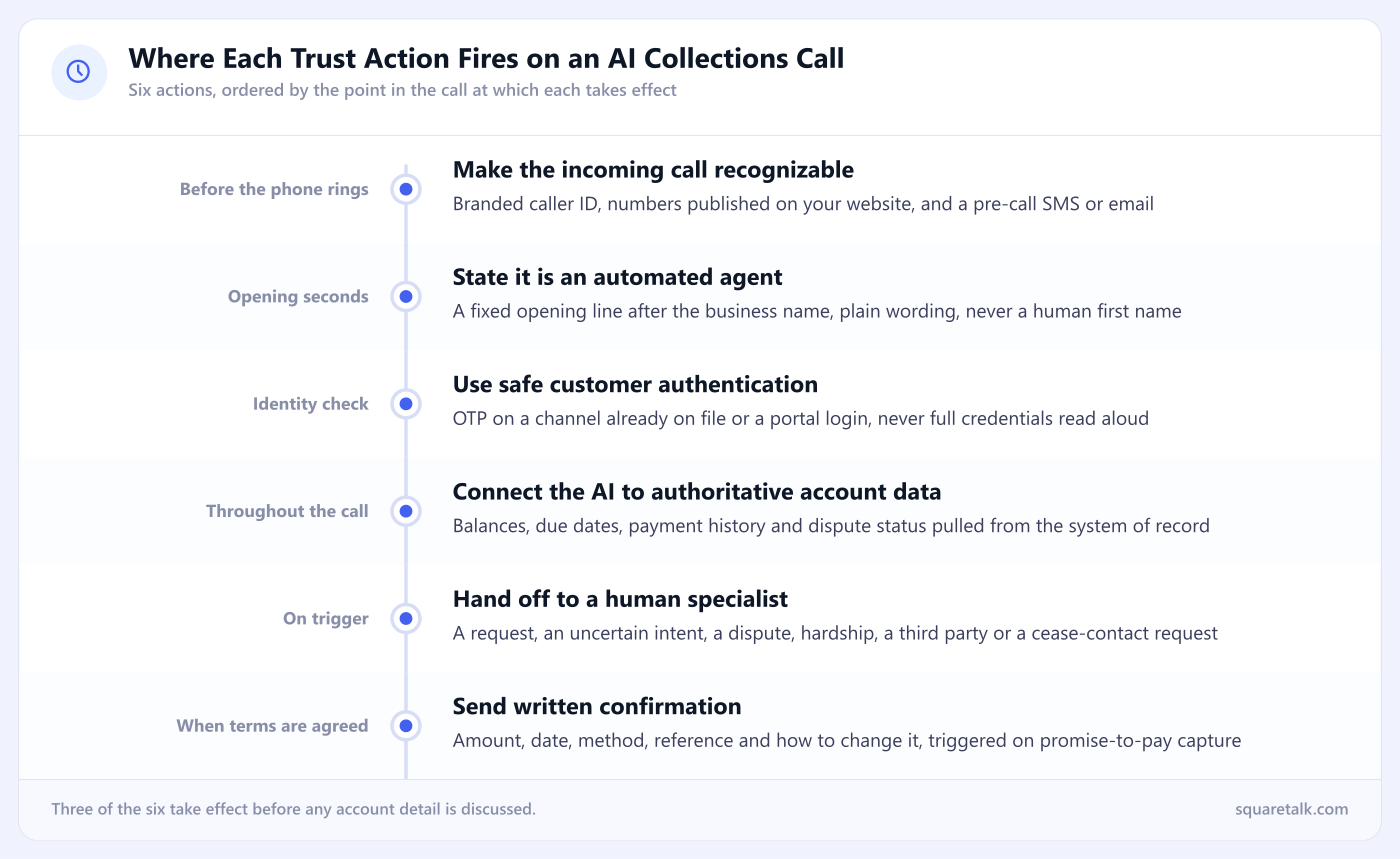
Make the incoming call recognizable
Recipients are understandably wary of automated calls from unknown numbers. According to TNS survey data, 37% of US adults received a scam call in the past year in which someone impersonated one of their financial providers, and 68% of Americans never answer calls from unknown numbers at all.
You can improve the debtor's perception enough for them to pick up by:
- Using branded caller ID
- Calling from numbers published on your company's website
- Notifying people via emails, SMS, or WhatsApp messages for an upcoming collection call
State it's an automated agent in the opening line
It's important to include this information after the business name instead of as a response to the "am I talking to a robot?" question halfway through the conversation. If disclosure is unclear or the voice is deliberately human-like, the customer can feel deceived once they realize the interaction was automated.
Another argument for early disclosure comes from COPC's 2025 research, which surveyed 1,000+ consumers across Australia, China, Malaysia, Singapore, the United Kingdom, and the United States: customers who knew they were interacting with AI reported satisfaction rates 34 percentage points higher than customers who were not informed. COPC attributes this to expectation-setting: when clients are told upfront that they are interacting with an automated system, they have a clearer sense of its capabilities and limitations. As a result, they are more likely to interpret an unanswered question as a technical limitation rather than as human incompetence that reflects poorly on the company or as a potential sign of fraud.
To implement AI voice agent disclosure correctly:
- Write it as a fixed opening line in your collection call script.
- Use plain wording such as "automated assistant" rather than a branded product name.
- Test that the disclosure remains clear across languages and call flows.
- Never give the agent a human first name to avoid misrepresentation or disguising the automation.
Build handoff protocols
Transfer debtors from the AI agent to a human specialist as soon as they request it, when the system reaches its confidence threshold, or encounters an escalation trigger for disputes, financial hardship, third parties joining the conversation, and cease-contact requests. These cases should be routed to a human proactively - missing a dispute or cease-contact request is both a service failure and a potential compliance risk.
To implement this:
- Train the system to detect both direct requests for a person, agent, representative, supervisor, specialist, "someone else", and indirect wording.
- Route customers immediately rather than asking "Are you sure?" or trying to keep them in the automated flow.
- Pass full context and a concise call summary to the human agent.
- Ensure the AI will escalate if uncertain about intent, account status, policy application, or what the person is asking.
Use safe customer authentication
The AI voice agent still needs to confirm it is speaking to the correct person before discussing sensitive debt information, but the goal is to reduce the trust the customer has to extend before authentication succeeds.
To implement this:
- Use OTP verification through a previously established contact channel, like WhatsApp or SMS.
- Allow authentication through an existing customer portal or app.
- Make account references from previous correspondence.
- Limit knowledge-based checks where appropriate.
- Avoid full passwords, banking credentials, or unnecessary sensitive information in the voice interaction.
- Separate identity verification from payment credential collection.
Connect the AI directly to authoritative account data
Customers will lose confidence quickly if the voice agent gives information that differs from what they already received in previous interactions, the customer portal, or from a human agent. Balances, payment history, due dates, dispute status, and account ownership should come from authoritative systems rather than being reconstructed by the language model.
Implement this by:
- Retrieving balances directly from the system of record, like a CRM or collections-management platform (CMP)
- Stopping or escalating the call if required account data is missing or inconsistent
Send written confirmation of anything agreed during the call
Amount, date, method, reference, and how to change it. A verbal commitment to a machine leaves the customer with nothing but their memory. A confirmation of the repayment-plan agreement, deadline, and payment method removes the "what did I just agree to" doubt afterwards.
To implement it:
- Trigger the message on promise-to-pay capture, so it arrives while the conversation is still fresh.
- Include a change-or-cancel path, so a customer whose circumstances shift can contact you instead of avoiding you.
- If the AI voice agent handles payment, build a procedure for it - send a secure link to details already on file or use a cloud payment solution like Key IVR.
Two practical implementations
An early-stage reminder campaign
A lender runs pre-due and one-to-thirty-day reminders through an AI voice agent across a large book of small balances. The agent opens the conversation with the company name and states that it is an automated call, which sets the expectation for a short, narrow interaction. The phone number the system uses to reach out is branded and checked for spam labels, so it displays as the lender rather than as unknown or suspicious. If a payment resolution is not reached during the call, the AI voice agent asks when to follow up, and the system automatically schedules the call for the preferred window instead of the next slot in the queue. If any agreements are made during the conversation, the system sends the terms to the debtor in writing via a message or email.
An inbound payment line
A collections operation delegates first-tier inbound inquiries to an AI voice agent so balance, due-date, and payment-status calls are also handled outside office hours. The agent discloses it's an automation, verifies the caller's identity, answers the questions, and, if needed, sends a payment link to the details on file. If a caller disputes the charge, mentions a redundancy, or asks for a person, the AI voice agent transfers the call immediately. The human collector opens the account with the summary of the last encounter already attached, eliminating the need for the customer to explain their situation again.
Where this leaves you
For collection managers, getting trust right protects AI voice agents' efficiency: more conversations are handled through automation, there is less avoidable workload for human specialists, and a cleaner path from first contact to resolution.
Each of the six actions removes a reason for the customer to disengage. A recognizable number stops the call from being mistaken for a scam. Disclosure removes suspicion of being misled. Handover protocols prevent the customer from being trapped in a system that will not let them through. Secure authentication gives them a safer way to confirm identity without handing over more information than necessary. Direct access to authoritative account data reduces the risk of the AI giving incomplete or incorrect information. And written confirmation gives debtors something concrete to refer back to after the call.
If you are (re)building your AI voice agent workflow, first evaluate which of these steps your current setup already covers and which need updating. Talk to our sales team today and see how Squaretalk's contact center software for debt collection can improve client trust in your operations.
FAQ
Should you tell customers they are speaking to an AI on a collections call?
Yes, and in the opening line rather than on request. COPC's 2025 research found satisfaction 34 percentage points higher among customers who knew they were dealing with AI than among those who were not told. Disclosure of this kind is also required in the EU under the AI Act.
Do AI voice agents recover less than human collectors?
Yale's research on AI collection calls found that promises made to automated callers were broken more often than promises made to human collectors, so the verbal commitment is weaker. That is an argument for confirming arrangements in writing and reserving human contact for more complex cases, rather than for avoiding automation on routine early-stage calls.
When should an AI voice agent hand off a debtor to a human collector?
On the first request, and automatically on a dispute, a hardship disclosure, a third party joining the line, or a cease-contact request. Build the transfer to recognize varied phrasing rather than a single scripted question, and attach a conversation summary so the customer does not repeat themselves.
Where do AI voice agents fit in a collections operation?
In first-contact and routine-contact work: pre-due reminders, early-stage past-due calls, right-party verification, promise-to-pay capture, broken-promise follow-up, and inbound balance and payment-status questions. Cases that need negotiation outside pre-approved parameters or involve a dispute should be handled by a human agent.